
AMIRI Menswear: A Wardrobe Assembled Around the Label
Because AMIRI is a Los Angeles house anchored to craft denim, deconstructed and repaired where it shows, that fact sits at the centre of any buying plan. The label is expensive enough that bringing together a wardrobe piece by piece, with a plan, works better than buying whatever is nearest to hand. Here, amiri clothing is treated as a modest set of anchor pieces, not an inventory of everything available. The prices below are observed market prices taken from 2026 retail listings, not an official price list. The target is a rotation that reads as deliberate at three very different spending levels. It assumes a handful of pieces rather than a full closet.
What the Purchase Buys
The brand puts its own start at 2014, the year Mike Amiri established the label in his hometown of Los Angeles, and the CFDA repeats that year. Against that sits the earliest contemporaneous document, a December 2014 press release dating the founding to 2013 in partnership with the Los Angeles concept store Maxfield, so the year remains genuinely contested. The debut was an exclusive capsule at Maxfield, which is why early pieces are thin on the ground. The work started with Amiri hand-crafting stage pieces for what the brand and the CFDA describe only as legendary Los Angeles performers, and while retail editorial has named specific rock clients, the house has not. Majority ownership is still his, while the Italian group OTB, chaired by Diesel founder Renzo Rosso, holds a minority stake taken in 2019 on undisclosed terms. It showed at Paris Fashion Week from 2018 and presents amiri there twice a year, yet remains menswear-first and American, with womenswear arriving in 2021.
Three Anchors
A workable version of amiri men’s dressing rests on three anchors, a single jean, a single shoe and a single jersey piece. Each carries a different share of the brand’s identity and fails differently if you choose badly. Denim is where the craft shows most, and it is where the money goes. In footwear, the bones motif that runs across every category is what registers at a distance. Jersey is where the logo does the work, and it is the easiest category to over-buy. Buying one of each, in that order, leaves you something wearable long before you have spent an outfit’s worth.
Denim Before Anything
The MX1 is the signature: a skinny-fit jean in Italian stretch denim, hand-distressed and repaired with pleated ovine leather, at an observed $1,090. The Stack sits at $750 and is the sensible entry point into core amiri jeans, with an intentionally long inseam engineered to concertina at the ankle. Read that extra length as the design rather than a fault; resist the smaller size. The Thrasher is the purest hand-distressed expression of the idea, abrasion and repair with none of the leather panel that defines the MX1; the Shotgun, by contrast, carries blown-out, sanded-edge holes and comes in straight-leg and skinny versions. If the skinny cut does not suit you, the Carpenter, Washed Baggy and MA Fit silhouettes are roomier, observed between roughly $705 and $1,345 before markdowns. Bandana and Crystal are treatments laid over these models rather than cuts of their own.
Shoes After Denim
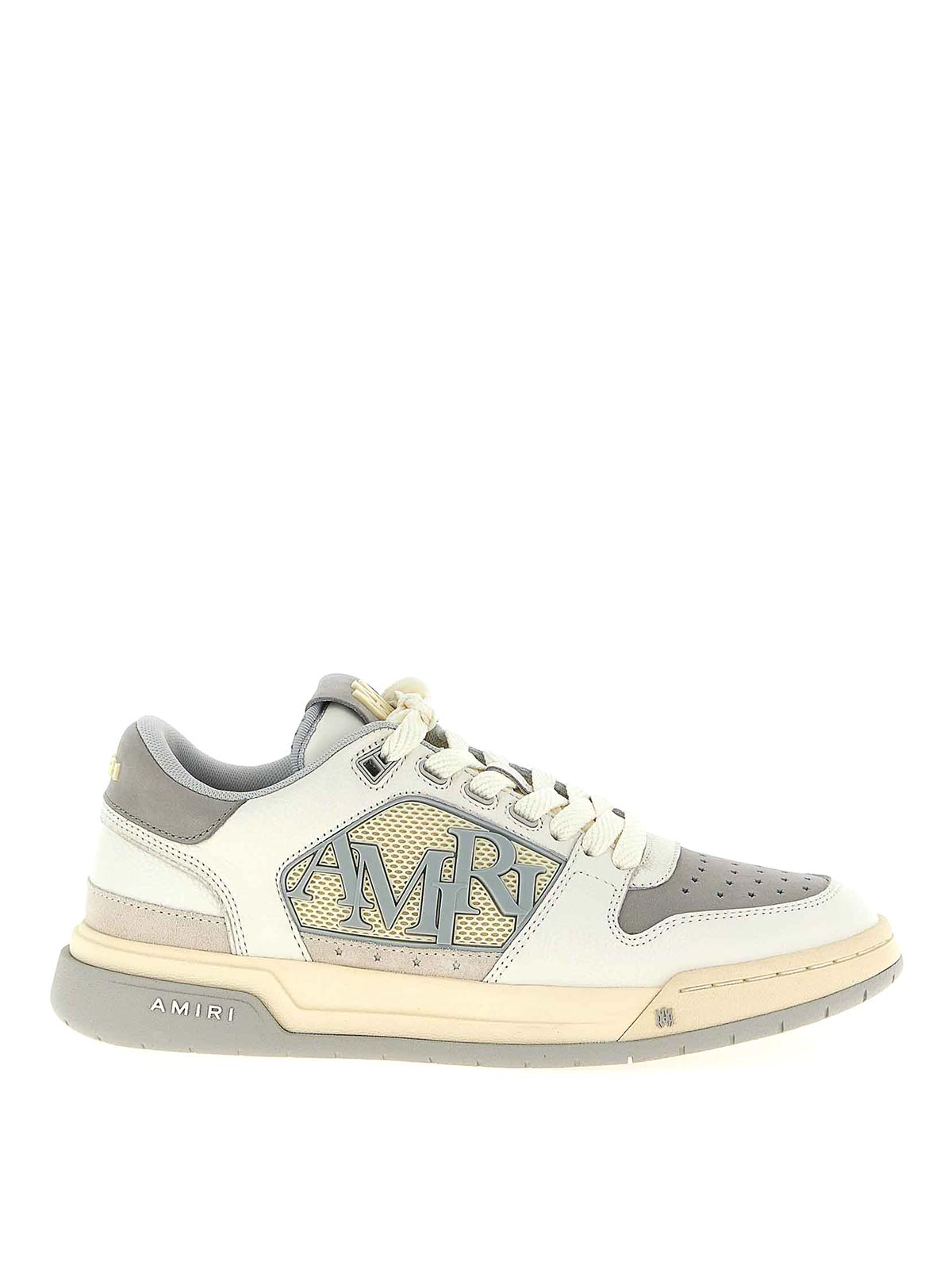
House signature sneaker is the brand’s own description of the Skel Top Low, a leather basketball silhouette finished with hand-cut bone appliqués in contrast topstitching. It is observed at $650 on the official site, having released at $590 in August 2020, so articles quoting the lower figure are stale. It is made in Vietnam, normal for the footwear line and not a sign that anything is wrong. A separate model is the Skel Court, a canvas retro-court style observed at $690; the Stars Court trades the bones for star appliqués and was refreshed for Pre-Spring 2026. Here the MA-1 denotes a sneaker, observed at $799, and not a bomber jacket, even though the designation belongs to military outerwear in other contexts. If you want a boot, the Ryder runs from $1,090 in leather to $1,190 in suede and $1,290 python-embossed.
Jersey to Finish
Take the MA Core Logo Hoodie as the benchmark: cotton, carrying the MA icon and core logo, described as a normal fit and observed at $650. Made in the USA, exactly as the MX1 and Stack jeans are, it is the case where the manufacturing story requires no caveat. Because an amiri hoodie sits among the most counterfeited shapes in the line, provenance carries more importance here than anywhere else. Tees run from roughly $425 for simpler graphics to about $930 for heavily worked pieces at authorised retail. Two products often conflated with each other are the MA Core Logo Tee and the MA Bar Logo Tee; the first is made in Italy and the second in Los Angeles. Varsity-patchwork zip hoodies have been observed above $1,300, jacket territory, so the plain one comes first.
Three Routes on Budget
Below, three routes reach the same wardrobe at very different costs, and every figure is an observed market price rather than any official price list. The first route pays full price for new stock through the brand’s own channel, spending on certainty. Waiting for authorised sale periods is the second route, and it works because discounting here is structural rather than occasional. In-season markdowns of roughly forty to seventy percent are visible at multi-brand stockists, with further reductions through off-price arms. The third combines a single new anchor with secondhand, which reduces the bill sharply but puts authentication risk on you. In the abstract none wins, because the trade is money against certainty and patience, and the anchor order does not move.
| Route | Anchor set | Observed outlay | Main trade-off |
|---|---|---|---|
| Full price, brand’s own channel | Skel Top Low, Stack jean, MA Core Logo Hoodie | $750 plus $650 plus $650 | Costliest route, cleanest provenance, full size runs |
| Sale periods, authorised only | Same three shapes from the previous season | Roughly 40 to 70 percent off list at multi-brand stockists | Gappy size runs plus last season’s colours |
| One new anchor plus secondhand | New sneaker, secondhand denim and jersey | MX1 asking prices observed near $400 to $840 against $1,090 retail | Buyer takes the authentication risk |
Fit Notes That Change What You Buy
Everything in this section is buyer-reported and retailer-guide material, because the brand does not publish complete garment measurements style by style. Cut deliberately close, the core skinny jeans, MX1, MX2, Thrasher and Stack, are summed up in fit guides as close to spray-on. True to the labelled size at the waist, the leg is where returns come from, and muscular thighs or calves commonly mean going up one or two sizes. Ready-to-wear is slightly trim, so one size up is the normal counsel, though not on pieces already named oversized, where sizing up compounds. Reports put the Skel Top Low true to size; the brand advises rounding a half size to the nearest whole size, and official sizing runs from 40 to 48 in European numbers. Stop that note at the Skel Top Low; for the other models no consistent reporting exists.
Buying Without Getting Caught Out
Exactly one official e-commerce channel exists, the brand’s own website, and it sits alongside roughly thirty-three owned boutiques, several of them marked as coming soon. The standalone count in trade reporting is about thirty-one; much larger figures in circulation, among them a claim of one hundred and ninety-five stores, conflate wholesale doors with owned shops. Authorised multi-brand stockists include Saks Fifth Avenue, Neiman Marcus, Nordstrom, Bergdorf Goodman, Maxfield, Harrods, Selfridges, SSENSE, Mr Porter and Mytheresa. Farfetch is the nuanced case: missing from that official online list, yet carrying deep stock through partner boutiques that are stockists in their own right. If you are typing buy amiri online, the stockist page is the reference to use, with the caveat that it is not closely maintained and still names a retailer that closed in 2024. No outlet exists, online or physical; any site presenting itself as one is not the brand, and discounted stock lives only in authorised sale sections and off-price arms.
Building the Rotation Over Time
Once the three anchors are in place, useful additions change the shape of an outfit rather than repeat it. A founding pillar is flannel, and a bleached quad-motif flannel has been observed at $1,290, which is outerwear money for sleeves that are not a hoodie. Denim outerwear follows naturally as the fourth piece: repair work jackets and studded truckers observed between roughly $1,815 and $1,880 at list, lower on sale. Varsity jackets are the loudest option and the most seasonal, observed above $2,300 at list. Hats, small leather goods, eyewear and bags all sit within the accessories side of the line, but belts are not a standalone category. Everything from kids’ pieces to handbags now carries the name amiri, and the wardrobe that works is the narrow one, so buy slowly, keep the invoices, and let the denim carry the outfit.